

Spectrum Calibration Nanobeads
PolyAn’s Spectrum Calibration Nanobeads can help adjust fluorescence-based detection systems such as flow cytometers, conventional fluorescence microscopes, confocal laser scanning microscopes, super resolution microscopes, and other image-processing systems.
PolyAn’s Spectrum Calibration Nanobeads are particularly useful to calibrate imaging setups for multi-color applications and to check their capability to resolve and co-localize very small fluorescent objects of different color in the same optical plane.
As Spectrum Calibration Nanobeads resemble the size of extracellular vesicles (EVs), they can also be used to adjust flow cytometers or other imaging platforms for EV detection. PMMA-Nanobeads compare favorably with polystyrene particles due to their lower refractive index (RI), which is closer to the RI of EVs.

SCB Nanobeads
Key features
PolyAn's Spectrum Calibration Nanobeads are monodisperse PMMA sub-micron particles that are available in different sizes with diameters between 100 nm and 600 nm. The beads contain a mixture of highly photostable fluorescent dyes that are homogeneously encapsulated within the PMMA matrix.
The Spectrum Calibration Nanobeads can be excited at any wavelength from 365–650 nm and emit at 400–750 nm, which enables their detection in all common fluorescence detection channels (DAPI, FITC, PE/TAMRA/Cy3®, APC/Cy5®, Cy7®) with only minimal photobleaching.
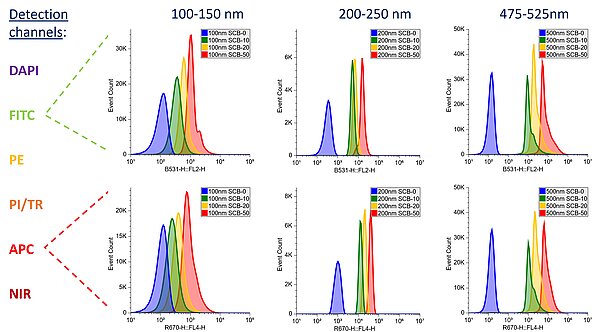
Spectrum Calibration Nanobeads with a particle size of ca. 125 nm (left), 225 nm (middle), and 500 nm (right) as measured in the FITC and APC detection channel of a CytoFLEX nano (Beckman Coulter Life Sciences) flow cytometer.*
Spectrum Calibration Nanobeads are available in all sizes from 100–600 nm upon request. Please enquire regarding different fluorescence intensities and other surface functionalities.
PolyAn also offers Spectrum Calibration Microbeads with sizes ranging from 2–20 µm. Please do not hesitate to contact our customer service for a custom development.
Publications
- Gudbergsson et al., `Dedicated nanoparticle flow cytometry for single extracellular vesicle phenotyping: Performance of the CytoFLEX Nano´, bioRxiv, 2025, DOI: 10.64898/2025.12.15.694348.
*Courtesy of Dr. Alfonso Blanco Fernández, Flow Cytometry Core Facility Director at University College Dublin, Conway Institute of Biomolecular & Biomedical Research